|
|
| |
|
|
| |
|
“Speak, Lord, your servant is listening.” Many associate the word
vocation
with priests or religious, but every Christian is called to discern God’s will. Life’s
larger
decisions require time, deeper thought, and more prayer. But even the small choices of each day should
be considered. Discernment is learning to recognize God’s quiet invitation. Is it His will or
yours?
|
| |
|
|

|
|
|
|
Roots
of Tradition
|
| |
|
Male Altar Servers
|
| |
|
Why have altar servers traditionally been young men? Many pastors uphold the
tradition of encouraging young boys to serve because the priesthood is reserved to men. Jesus chose
twelve men as His Apostles. Studies have found that a large majority of men discerning the priesthood
once served at the altar. The altar — where the sacred mysteries are celebrated — is often
the
place where young men first encounter the possibility of a priestly vocation. Older, experienced
servers mentor the younger ones, friendships form, the bond of brotherhood strengthens, and the
tradition continues.
|
| |
|
|
|
|
|
|
| |
|
|
| |
|
From Benedictine to the Bronx |
| |
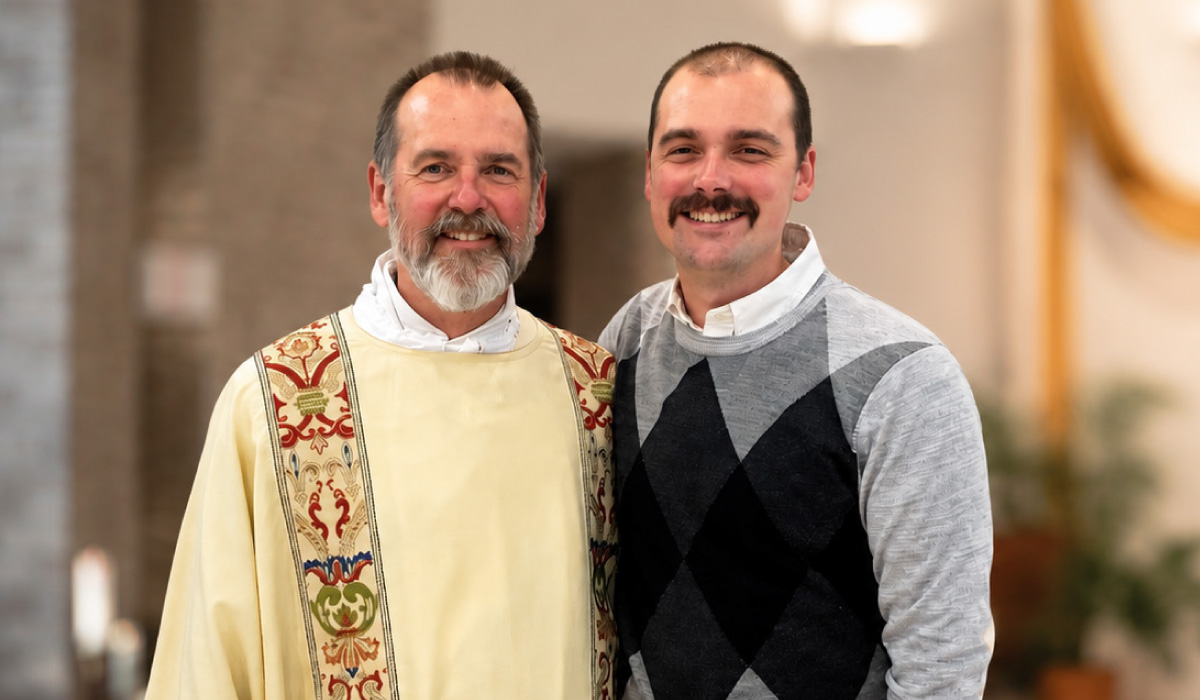
Gabriel Maday (right) with his father, Rev. Mr. Jason Maday.
|
|
Faith Matters spoke with Gabriel Maday just weeks before he was scheduled to leave for New York to
begin a year of service and discernment as a Seton Teaching Fellow. We hope to follow his story
for years to come.
|
|
| |
|
At twenty-two, Gabriel Maday graduated from Benedictine College and is about
to leave for the Bronx, where he will spend a year teaching at a tuition-free public charter school in
one of the city’s poorer neighborhoods while continuing his discernment with the Dominican
Order.
The Dominicans have asked him to spend the year living in community as a Seton Teaching Fellow before
taking the next step in his vocation. The coming year will test whether that calling is truly where
God is leading him.
The placement is not incidental. “The beauty of that is I’ll be in the Eastern Province of
the Dominicans, which has a big presence in Manhattan,” he said. “I’m really excited to be
that close.”
For many Catholics, the word vocation calls to mind a priest at the altar
or a sister in a classroom. What goes mostly unseen are the years before: the prayer, the formation,
the small faithful decisions that prepare a person for God’s call. Gabriel’s story offers a
window into that journey. We met him not at the end of his discernment, but in the middle of it.
|
|
|
|
“I don’t want the liturgy to be beautiful for my sake, but because God deserves so much more
than we can give Him.”
GABRIEL MADAY
|
|
|
|
His mother, Beth, says it started at five. Gabriel says seven. Either way, it
started early — a quiet certainty, held loosely at first, that the priesthood was where he was
headed. Most childhood dreams fade with time. Gabriel’s came into focus.
|
| THE FOUNDATION
AT HOME |
|
His parents built the foundation. His father, Rev. Mr. Jason Maday, was ordained a permanent deacon
in April 2026. A cradle Catholic, he deepened his faith through study. His mother converted to
Catholicism before they married. The household prayed the rosary every evening, and Adoration was a
regular practice. “They were both the head and the heart guiding me and my two younger
sisters.”
He received his First Communion at seven and was serving at the altar the
following weekend. He has served ever since. The roots of his vocation, as he understands them, run
directly through that experience — the liturgy, the nearness of it, the demand it placed on him to take
God’s worthiness seriously. “I don’t want the liturgy to be beautiful for my
sake,”
he said, “but because God deserves so much more than we can give Him.”
His pastor, Fr. Libby, shaped him too. “He never asks us to do
something that he isn’t doing himself,” Gabriel said. “Which is huge in
formation.”
|
| A MOMENT IN A
CLASSROOM |
|
Those years of quiet formation eventually led to a defining moment.
During a freshman theology class in high school, something unexpected happened. A general discussion on religious
orders — no particular drama, no preparation for what followed. Then, in the middle of it,
something settled over him: an overwhelming love and desire for the Dominicans. It lasted only
fifteen seconds. Later that day, during science class, it returned and stayed for fifteen minutes.
The conviction remained, but the path was anything but straightforward.
He visited the Pontifical College Josephinum in Ohio to explore diocesan priesthood. “I was
miserable the whole weekend,” he said plainly. The diocesan life was not his calling; once he
accepted that, something else opened. “Once I realized that I was made for communal life and I
began to fall in love with study — which ultimately includes teaching, preaching, and being out
in the world — the more I realized that religious life was my call, specifically with the
Dominicans.”
|
|
|
|
“It’s the community that you fall in love with, and it can be thought of as coming
home.”
GABRIEL MADAY
|
|
|
|
He spent years among the Benedictines in college, and he loves them with
evident sincerity. But prayer kept returning him to the same answer. “The Lord kept saying,
‘You could, but that’s not what I’ve made your heart for.’” Even then,
he never
experienced it as coercion. “The choice was always mine.”
|
| WHAT MOST
PEOPLE MISS |
|
Gabriel thinks Catholics misunderstand what it means for a man to enter religious
life. Women entering religious communities is familiar enough; men doing the same is less understood. “At least for men, the
vocation is for a specific community, not to be a priest or a monk,” he said. “It’s
the
community that you fall in love with, and it can be thought of as coming home. Wherever you are,
whatever you are doing, you are a Dominican, or you’re a Jesuit, or a Benedictine.”
|
| |
|
|
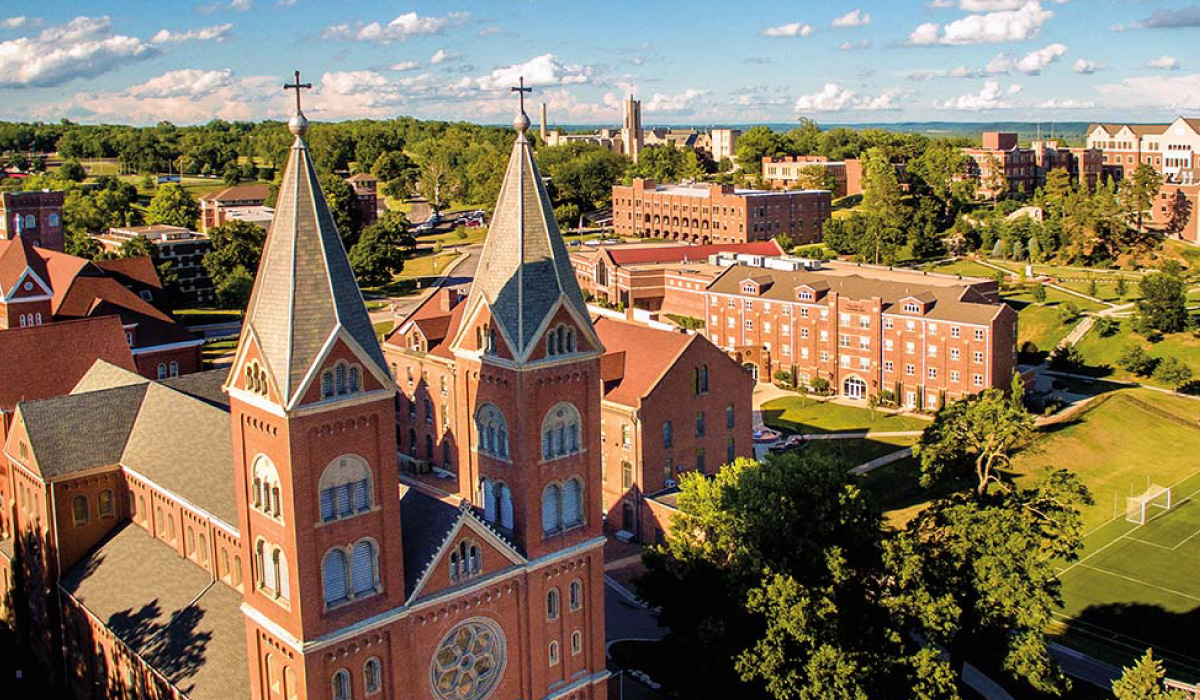
Benedictine College in Atchison, Kansas |
| |
|
His daily life already reflects that orientation. The rosary is, as he
puts it, the “non-negotiable of non-negotiables.” “Even if I don’t make it to
Mass, I’ll
always pray the rosary. It has transformed my life and my vocation.” He prays the Office of
Readings
and Evening Prayer, pursues Eucharistic Adoration when he can, and ends each day with an examination
of conscience.
|
| A DIFFERENT
KIND OF FORMATION |
|
Benedictine College formed him in other ways. Professors, monks, choir
directors, and spiritual mentors each helped shape the man he was becoming. But serving as a resident
assistant became one of his most important classrooms — relational, humbling, less tidy than
intellectual growth alone.
“Prior to college I think I wasn’t the most charitable person. Things
were very black and white. Being an RA made me more charitable, and I was able to open up to people
and just say I love you. It was very humbling. I had to learn how to meet people where they were at
and love them.”
|
| |
|
|
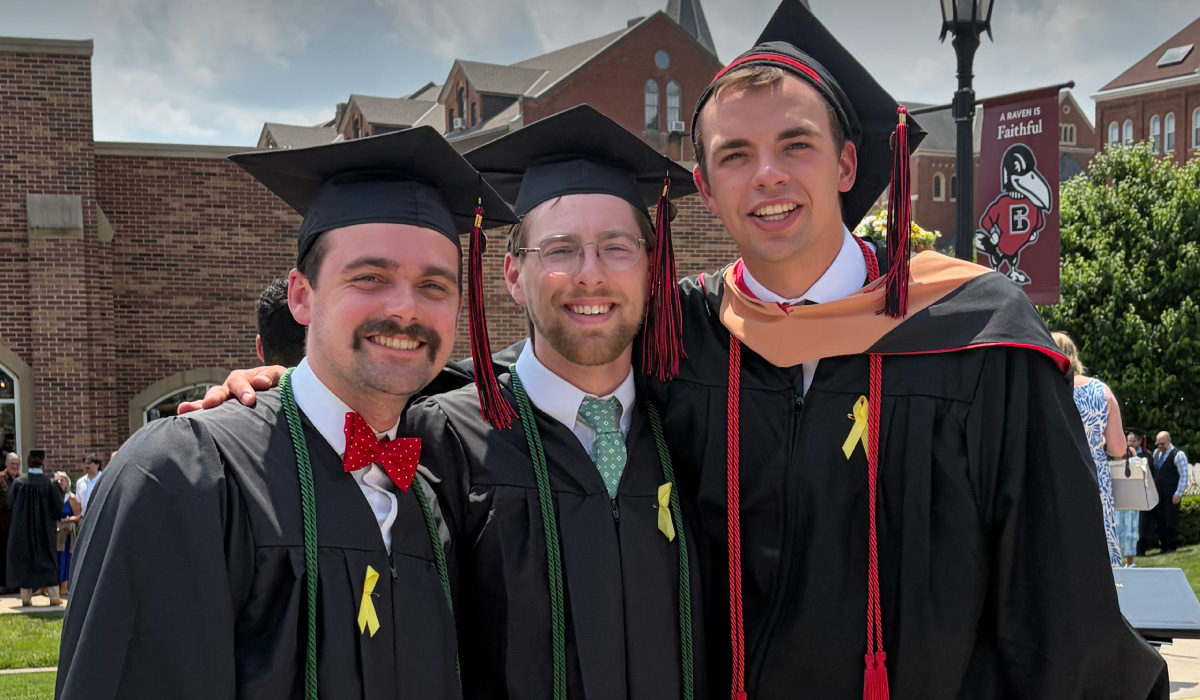
Gabriel Maday (left) with fellow Benedictine graduates |
| |
|
For all that the Benedictines gave him, leaving them was its own kind of grief. “I truly wish I was
called to that order because I love all of them and it was an amazing time,” he said. “But I
just wasn’t called to the Benedictine life.”
|
| WHY THE
DOMINICANS |
|
Ask Gabriel what drew him to the Dominicans and he answers without hesitation: the
integration of prayer and study, the conviction that the two are not competing claims on a man’s
time. “I love how prayer and study are not separate, and the conclusion of that is to go out and
tell
the world.”
Study, in the Dominican tradition, is itself an act of sacrifice. He
quoted a saying he has carried with him: “There’s a beautiful saying in the Dominican
community that
the wood of the desk is the wood of the cross — meaning that blood, sweat and tears are poured
out in your study.”
|
| |

|
| |
|
He is twenty-two years old. He has a classroom in the Bronx, a community
to live with, and a year ahead of him that will test everything he believes God is calling him to
become. He hopes to keep serving at the altar and cantoring if the opportunity arises, but, as he
put it, the community comes first.
The next year will ask much of him. As he seeks to follow God’s will
wherever it leads, we invite you to keep Gabriel in your prayers as we look forward to the next chapter
of his story.
|
|
|
|
Gabriel Maday graduated from Benedictine College in May 2026 on a
full academic scholarship, with bachelor’s degrees in Theology and Philosophy.
|
| |
|
|
|
|
|
|
|
By
the Numbers
|
|
|
|
| |
|
Was this issue forwarded to you? |
| |
|
If you’re not already subscribed, sign up to receive future issues of Faith Matters. |
| |
| SUBSCRIBE
|
| |
|
To unsubscribe from Faith Matters emails, use the unsubscribe link included in the email you received. |
| |
|
|
| |
|
Schwartz Investment Counsel, Inc., a registered investment adviser established in 1980,
serves as investment adviser for Ave Maria Mutual Funds. The Adviser invests in securities only if they meet
the Funds’ investment and religious requirements, and as such, the returns may be lower or higher than
if the Adviser made decisions based solely on investment considerations. The Funds’ method of security
selection may or may not be successful and the Funds may underperform or outperform the stock market as a
whole. All mutual funds are subject to market risk, including possible loss of principal.
Request a prospectus, which includes investment
objectives, risks, fees, expenses and other information that you should read and consider carefully before
investing. The prospectus can be obtained by calling 1-866-283-6274 or it can be viewed and downloaded here. Distributed by Ultimus Fund
Distributors, LLC. Schwartz Investment Counsel, Inc. is not affiliated with Ultimus Fund Distributors, LLC.
|
| |
|
20260714-5738956
|
| |
|
|
|