|
|
| |
|
|
| |
|
We spend much of our lives preparing for the future—our careers, families, finances, and retirement. The Feast of the Assumption asks a more enduring question: Am I preparing for eternity? One traditional fruit of the fourth Glorious Mystery is the grace of a happy death—not a morbid preoccupation, but the confidence of a life entrusted to Christ. Mary’s faithful “yes” was lived across a lifetime, and her Assumption reveals that brokenness and death do not have the final word.
|
| |
|
|

|
|
|
|
Treasury
|
| |
|
A Thirty-Three-Day Journey
|
| |
|
The thirty-three-day preparation for total consecration to Jesus through Mary is most closely associated with St. Louis-Marie Grignion de Montfort (1673–1716), a French priest and one of the Church’s most influential advocates of Marian devotion. For de Montfort, devotion to Mary is always Christ-centered: its purpose is to lead us into deeper union with Jesus.
The traditional preparation includes daily prayers, readings, and reflections divided into four periods. The first twelve days focus on freedom from the spirit of the world. Three seven-day periods follow, devoted to knowledge of self, knowledge of Mary, and knowledge of Jesus Christ. On the following day—often chosen to coincide with a Marian feast—the participant makes the formal act of consecration to Jesus through Mary.
For those who wish to explore the devotion, de Montfort’s True Devotion to Mary provides its spiritual foundation and traditional method. Father Michael Gaitley’s 33 Days to Morning Glory draws from the same tradition in the form of an accessible contemporary retreat. Both present consecration not as a single devotional moment, but as a way of renewing one’s baptismal commitment and placing one’s entire life more completely at the service of Christ.
|
| |
|
|
|
|
|
|
| |
|
|
| |
|
Our Lady of the Broken |
| |
|
|
|
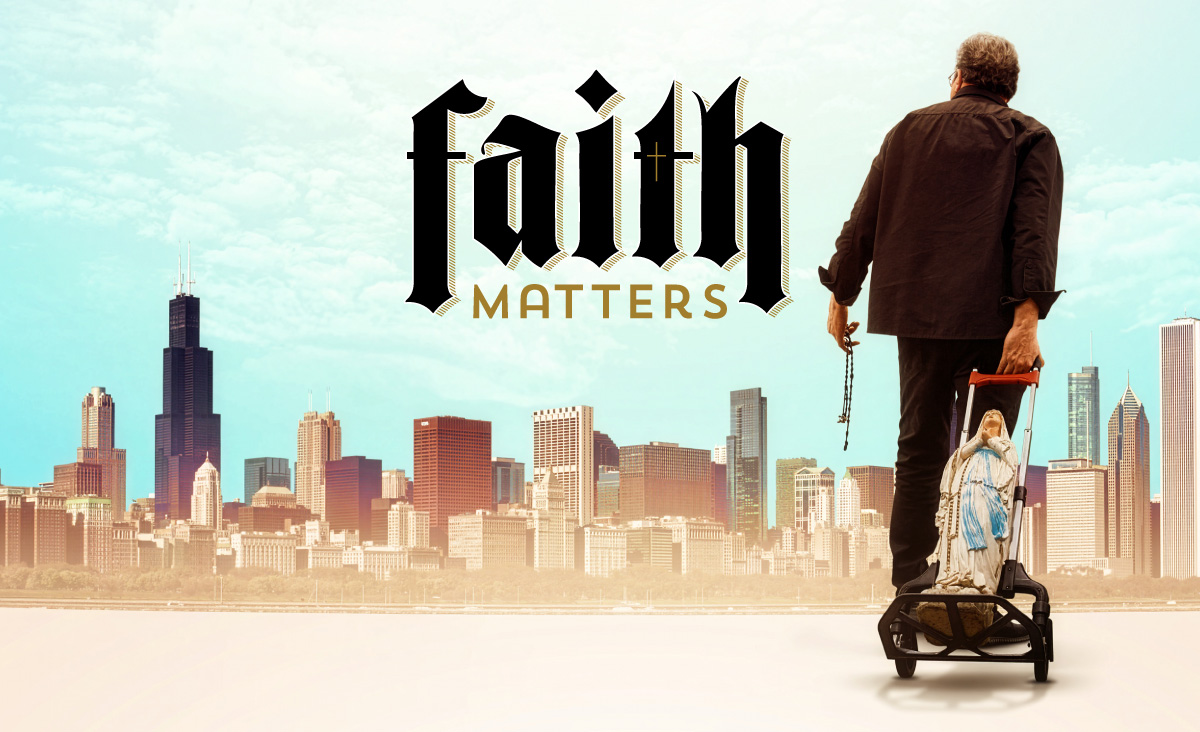
Faith Matters spoke with Kevin Matthews, Chicago radio legend and founder of the Broken Mary Project, about a childhood shaped by chaos, a career built on performance, and the broken statue that redirected everything.
|
|
| |
|
The statue was missing its hands. Its face had been cracked through. Someone had left it beside a dumpster, and that is where Kevin Matthews found it. Matthews was not looking for a sign. He was in the middle of a medical crisis, newly unemployed, and confronting what it meant to have a body that had begun to fail him. Multiple sclerosis had replaced what was originally feared to be a brain tumor, trading one kind of dread for another, longer kind. He took the statue home and has not been separated from it since.
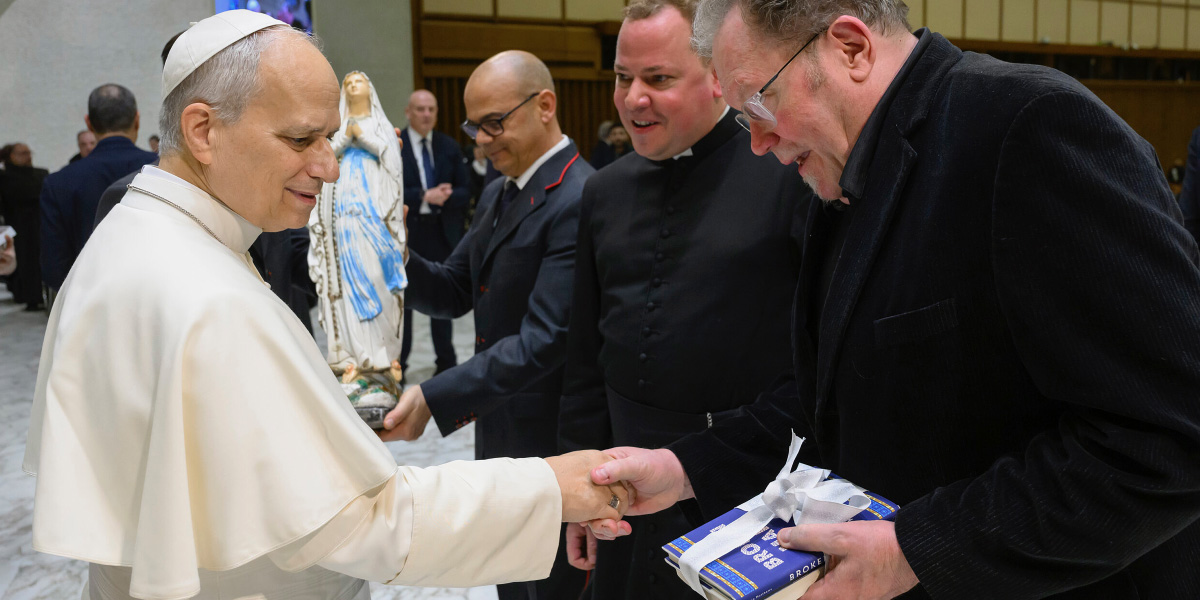
That was about sixteen years ago. Today, Matthews carries the statue to parishes, hospitals, and public processions across the country. Earlier this year, he brought it to Rome, where Pope Leo XIV received him and blessed the statue. According to Matthews, the Pope affirmed the title Our Lady of the Broken after saying that “the world is broken.” Matthews has since written two books about the journey, Broken Mary: A Journey of Hope and Mary’s Roadie: My Travels with Mary the Mother of Jesus, and a documentary bearing the statue’s name screened in theaters nationwide on the feast of Our Lady of the Rosary in October 2025. None of this, by his own accounting, was the plan.
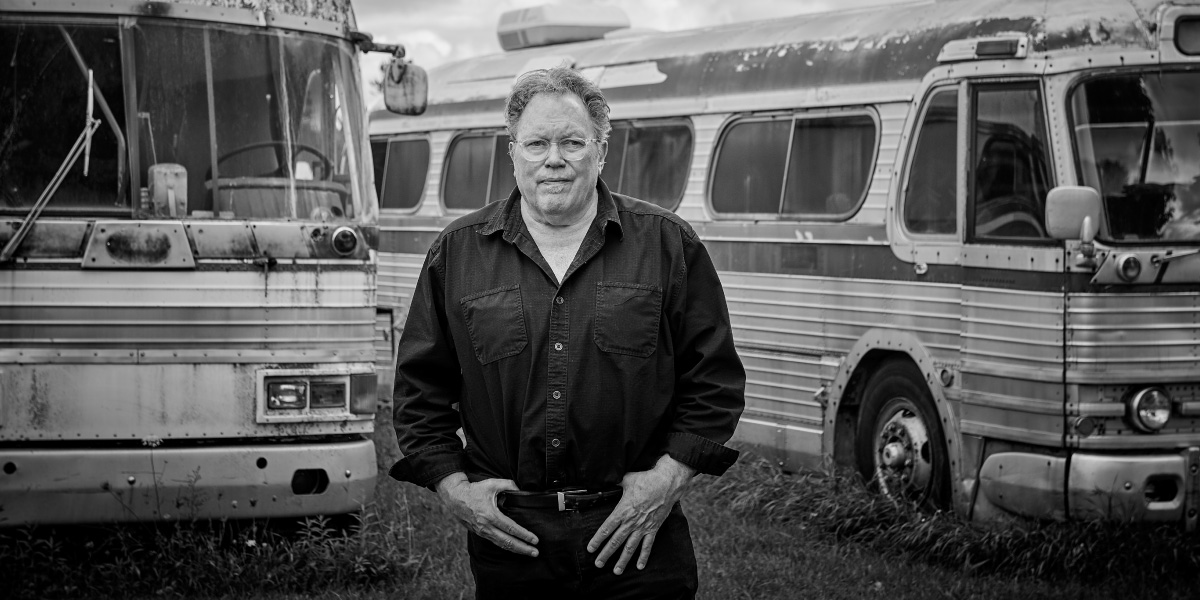
Matthews grew up in Pontiac, Michigan, outside Detroit, in circumstances he describes without softening. “It was a pretty tough town in those days,” he says. “Vietnam, race riots—my household growing up wasn’t easy, my dad and drinking were issues. So there was turmoil inside and outside of our home.” He was a cradle Catholic. One side of his family was Irish Catholic; they attended Mass and were devoted to the faith. On the other side was a grandfather who belonged to the Ku Klux Klan, whom Matthews describes simply as “somewhat demonic.”
|
| |
|
| |
|
“I felt like a junkyard dog,” he says. “I did everything I needed to do to survive, as I felt like I was on my own for the most part.” That instinct for survival carried him out of Pontiac and into Chicago radio, where he became one of the city’s most recognizable voices during the 1980s and ’90s. At the height of his career, his show on WLUP drew an estimated 10 million listeners per week. He was known for impersonations, pranks, and a willingness to push. The persona matched the era, but it did not answer anything deeper.
|
|
|
|
“The statue represents the world to me. The brokenness is me, it is the world. We are all broken.”
KEVIN MATTHEWS
|
|
|
|
When his health collapsed and his career followed, the turning point was immediate; the rebuilding was not. Doctors initially believed the problem was a brain tumor. “I was literally preparing to die,” he says. “If that was the case, I would have died before I found the statue, we wouldn’t be speaking, and I’d be in Hell. No question.” The diagnosis was eventually revised to multiple sclerosis, which is incurable but not immediately terminal. By the time he encountered the statue, Matthews had also lost his job.
“I immediately related to the statue because it was being thrown out,” he says. “That’s somewhat how I felt.” He resisted, and continues to resist, any effort to repair or repaint it. The brokenness, he says, is the point. “The statue represents the world to me. The brokenness is me, it is the world. We are all broken.”
The return to faith was gradual in form but immediate in direction. Matthews describes it as a daily process, shaped significantly by Father Mark Beard, whom he calls a friend and mentor. “He took me under his wing and slowly helped me along the road,” Matthews says. “When you return to the Church or Christ, it’s a process, and that’s what happened.”
Matthews credits Father Beard as a central influence in his understanding of Catholic teaching on heaven, hell, and purgatory. Father Beard has since passed, but Matthews says his recorded homilies remain an ongoing source of formation. “Repent means change, and people generally don’t want to change,” Matthews says. “There’s no exit in hell—you are there. And eternity is a long time to be wrong.” He does not soften these positions; they sit at the center of his message, not at the margins.
|
| |
|
| |
|
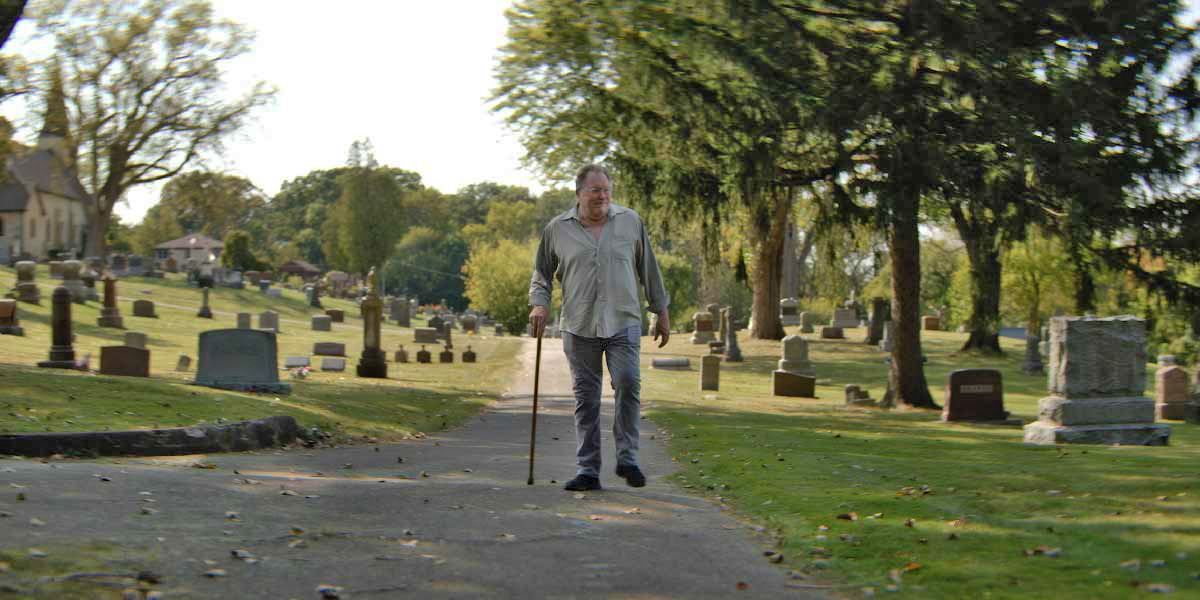
Living with MS has not retreated into the background. It remains an ongoing, physical presence in Matthews’s daily life, and he has come to understand suffering through the Catholic practice of offering it up. “I’ve learned that suffering is part of life,” he says. “Jesus suffered, and I think the best prayer I can give to Him is myself. When I’m sore, tired, and just ache, I give it all to Jesus as my prayer for the conversion of sinners. The one thing I can truly give to God is my suffering.”
His counsel for those who feel broken but have not yet moved toward faith is practical and Catholic in its specificity: receive the sacraments regularly, go to confession, and pray the Rosary. He describes the Rosary in his own terms: “The Rosary is Mary’s umbilical cord, in my opinion. That’s how she feeds us.” When asked what keeps people from exploring or deepening their faith, his answer is characteristically direct: “Satan. God is hated and sin is loved in the world today.”
|
|
|
|
“The one thing I can truly give to God is my suffering.”
KEVIN MATTHEWS
|
|
|
|
What Matthews carries now is different from what he carried at the height of his career. The statue still travels with him to parishes and processions, hospitals and people who feel discarded. None of it resembles his years at the top of Chicago radio, but that is no longer the measure of his life. “My relationship with God is all I have, and He’s not changing,” he says. “He created everything, He’s given me everything, and without Him I have nothing—not my wife, kids, my health. Nothing.”
Matthews says he made a covenant with God to become what he calls “His shepherd dog” and bring people back. “I didn’t really know I was on mission,” he says. “I took life back then one prayer at a time.” The statue is still broken, and he has kept it that way on purpose.
|
|
|
Kevin Matthews and the Broken Mary Project can be found at brokenmary.com. |
| |
|
|
|
|
| |
| |
|
Did you find this issue meaningful? |
| |
|
|
| |
|
|
| |
| |
| |
|
Was this issue forwarded to you? |
| |
|
If you’re not already subscribed, sign up to receive future issues of Faith Matters. |
| |
| SUBSCRIBE
|
| |
|
To unsubscribe from Faith Matters emails, use the unsubscribe link included in the email you received. |
| |
|
|
| |
|
Schwartz Investment Counsel, Inc., a registered investment adviser established in 1980,
serves as investment adviser for Ave Maria Mutual Funds. The Adviser invests in securities only if they meet
the Funds’ investment and religious requirements, and as such, the returns may be lower or higher than
if the Adviser made decisions based solely on investment considerations. The Funds’ method of security
selection may or may not be successful and the Funds may underperform or outperform the stock market as a
whole. All mutual funds are subject to market risk, including possible loss of principal.
Request a prospectus, which includes investment
objectives, risks, fees, expenses and other information that you should read and consider carefully before
investing. The prospectus can be obtained by calling 1-866-283-6274 or it can be viewed and downloaded here. Distributed by Ultimus Fund
Distributors, LLC. Schwartz Investment Counsel, Inc. is not affiliated with Ultimus Fund Distributors, LLC.
|
| |
|
20260805-5809555
|
| |
|
|
|