
A Catholic in the Public Square
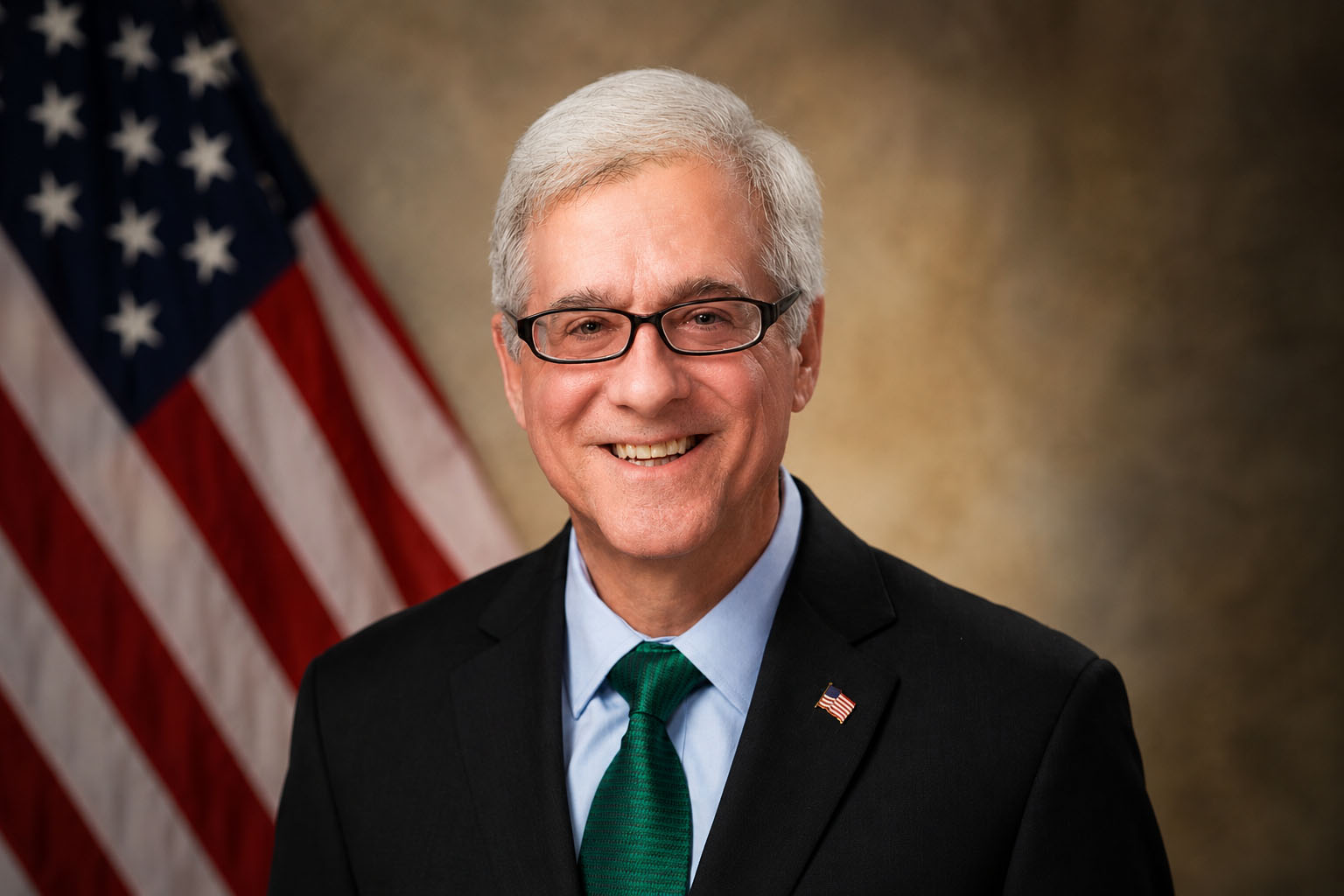
Michael Heyeck is an engineer, former city councilman, and author whose reflections on faith and public service are rooted in a lifelong search for purpose and the Common Good.
My family was Catholic. We rarely went to Mass.
My father converted to Catholicism for my mother, and faith was present in the home, but not practiced in the pews, at least not by my parents. They had endured real hardship: the loss of their first child at three months, the death of my mother’s closest sibling at twenty-seven, my father’s near-fatal accident, then bankruptcy in the 1960s. I have often wondered how faith helped them carry all of that.
What they did give me was a respect for Catholic teaching. I attended weekly religious instruction through ninth grade. And for reasons I still cannot entirely explain, I went to Mass – even when my parents did not. As the oldest of three boys, I eventually brought my brothers with me. Whether it was duty or something else, I am glad I went.
One person, almost entirely: Fr. Francis DiGiorgio, the pastor of Our Lady of Mount Carmel in Newark, New Jersey. He had a way with children. He would come into our catechism classes and test us on our memorizations. He heard my first confession before First Communion. For an Italian-American neighborhood built around its parish, he was the center.
He died in 1979 from a heart attack at sixty-two, after playing soccer with the youth at the parish. That tells you something about the man.
The concept of the Common Good sits at the heart of Catholic teaching, and it sat at the heart of everything I tried to do. My mother instilled a sense of public service in me before I understood it as a vocation. My faith helped me keep principles ahead of party.
Public service takes many forms: elected office, professional work, charitable effort. You do not leave your faith at the door when you enter any of them. It is part of who you are. I could not have served without my faith, and I could not have sustained either without my family.
It came later. For years I was a “lazy Catholic” – Mass on Sundays, faith in a compartment, the rest of life arranged around it rather than through it.
Then a moment changed everything.
On November 24, 2019, Fr. Jonathan Wilson, pastor of St. Paul the Apostle, gave a homily on the Feast of Christ the King. I was in New Jersey for Thanksgiving and missed it, but a friend told me to listen to the recording. Fr. Wilson, drawing on St. John Paul II, called Catholics to move beyond the walls of the Church and into the public square. When I heard it, I recognized for the first time the tension between my faith and life in the public square.
I arranged to meet Fr. Wilson on January 22, 2020. He texted that he was running late. I went into the church and sat alone in the quiet and the dark.
He was there. I felt it. I said to myself: this is my Church.
When we met in his office, the tension rose within me. I blurted out twice, raising my voice: “This is my Church.” We were both surprised. Then I asked for a confession.
I can date everything that followed back to that afternoon. Recalling it still brings tears.
As a coexistence, not a wall.
The phrase “wall of separation” comes from Jefferson’s 1802 letter to the Danbury Baptists, not from the Constitution. The Constitution says only that Congress shall make no law establishing religion or prohibiting its free exercise, and that no religious test shall be required for public office.
Alexis de Tocqueville, arriving in the young republic as an outside observer, saw it clearly: “Although religion in the United States never intervenes directly in government, it must be considered as the first in America’s political institutions.”
In Westerville, I watched both sides of this. After 168 years, there were efforts to eliminate the council’s opening invocation. I argued that all were welcome to offer one, regardless of tradition. The practice remains today.
In 2022, after the Supreme Court overturned Roe, the council voted on a resolution supporting abortion rights. I cast the only vote against it. The resolution had no legal force. But I could not separate my faith from my vote, and I did not try.
American history and Catholic theology, mostly. George Weigel, Scott Hahn, Steve Weidenkopf, Pope Benedict XVI, St. Augustine, Chesterton. I am also working through all of David McCullough – currently The Path Between the Seas, his book on the Panama Canal. I am an engineer. It works on two levels.
I am approaching a thousand books. I still find that each one opens into something I had not considered.
Weekday Mass, when I can. St. Paul the Apostle on a quiet morning is different from a Sunday – smaller, stiller. He is there. That is where my faith deepened in 2020, and I continue to find both peace and direction in that space.
A few times each month, I bring the Eucharist to a nursing home after Mass. As a lector, before I read, I pray: “Make me a fit instrument for You.” I say the same prayer before council meetings. I return often to Psalm 51.
The prayers are not unusual. The practice of returning to them is what matters.
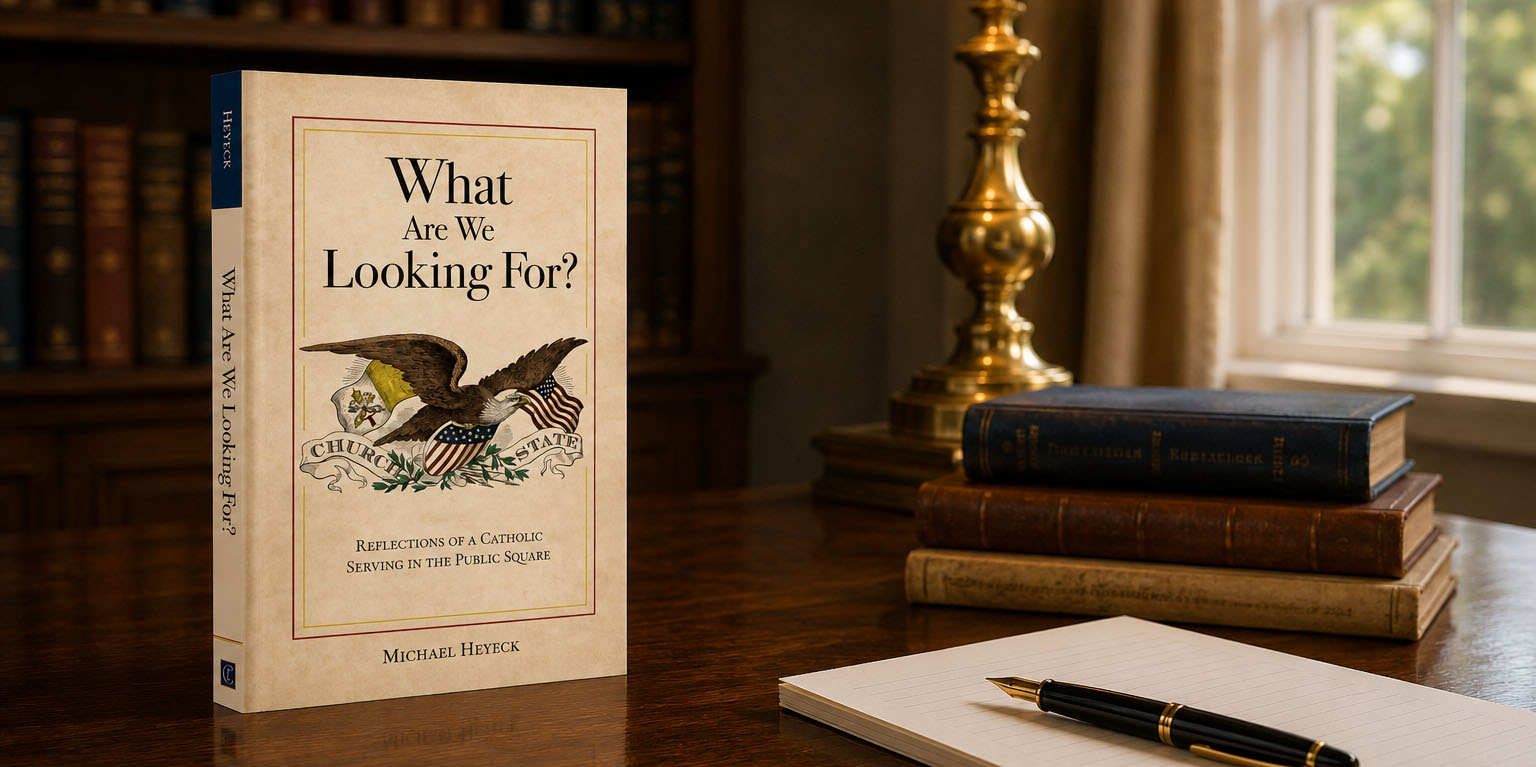
Two moments, separated by twenty-five years, led me to write this book.
Fr. Wilson’s homily was the spark. His foreword opens the book. He had studied the Common Good philosophically and helped me understand what I had been living without fully articulating.
But the deeper prompt came from 1994. My brother asked me to take him to confession the day after Thanksgiving. Afterward, sitting together, he asked me: “What is my purpose?”
He died six months later at thirty-seven.
That question did not leave me. The title came from where that search eventually led me. Jesus’ first words in St. John’s Gospel – “What are you looking for?” – struck me differently once I had heard my brother ask it. St. Andrew had just followed him. Jesus turns and asks. I came to that passage through a Confession in 2012, when a priest asked as I was leaving: “Do you lead a prayerful life?” My mouth moved before my mind did, and I said yes. After I left, I knew I had not been honest. So I did what I had always wanted to do: I read the Bible from Genesis to Revelation, then the Catechism, then the American translation. A year and a half in total. That question stayed with me the entire time.
The book is, in part, my attempt to answer both of them.
Anyone who serves. That is a wider category than it sounds.
The Common Good is not the exclusive property of elected officials. It is served in the work we do for a living, in volunteer work, in the quiet maintenance of families and communities. The Catechism speaks to all of it.
My own path was not linear. Faith, work, and office were often in tension with each other before they were in alignment. But looking back, it is faith and family that made everything else possible. If the book helps someone recognize their own path as a vocation – whatever form that takes – then it has done its work.
Do not be afraid.
The secular world wants faith kept inside the walls of the Church. It presses people to be ashamed of bringing their beliefs into decisions, into office, into work. I was told as much, directly, at a council meeting.
Hold the line. Your faith is not a liability in the public square. It is what keeps principles ahead of politics. The journey will not always be easy. But it is the right one.
One, from August 2020.
I arrived at an early weekday Mass during the COVID pandemic – lightly attended, quiet. Before Mass began, I felt moved to light a candle for a couple I knew. They were expecting a daughter, Josephine, who was not expected to survive long after birth. They had lost another child at birth the year before.
I rarely light candles. Something moved me that morning. I lit one, on August 14th, the Vigil of the Solemnity of the Assumption of the Blessed Virgin Mary.
Later I learned what had been happening while I was in that church.
The mother had been diagnosed with a pulmonary embolism in January – the leading cause of maternal death during pregnancy. There were fears of another clot. After consultations with doctors, ethicists, and priests, the couple had scheduled an induction for August 15th, the Assumption, entrusting Josephine to Our Lady. They were at peace with the decision, but they were also afraid they had chosen wrongly.
On August 14th, while I was lighting the candle, Josephine began labor on her own – more than five weeks early. The doctors were shocked.
The mother later told me that while I was in that church, God had lifted the moral burden from their hearts. Josephine had begun labor on her own, more than five weeks early, on the very day before their scheduled induction. She received her sacraments from Fr. Wilson and died peacefully as the Assumption Vigil began. The mother’s words to me: “Natural labor the very day before our agonizing decision for an early induction was not a coincidence.”
Josephine lived for just over two hours. She received all the sacraments. Fr. Wilson saw her as the Little Flower – Saint Thérèse of Lisieux. Josephine was perfect. That perfection is now everlasting.
None of it was coincidence. How can anyone not believe?
The Holy Spirit will touch you in some way. Do not miss it.
Michael Heyeck’s book, What Are We Looking For? Reflections of a Catholic Serving in the Public Square, is available at catholictreehouse.com.
The author’s proceeds benefit the Michael and Fernanda Heyeck Endowment Fund, dedicated to St. Paul the Apostle Church, Westerville, Ohio, held by the Foundation of the Catholic Diocese of Columbus.
 Website